
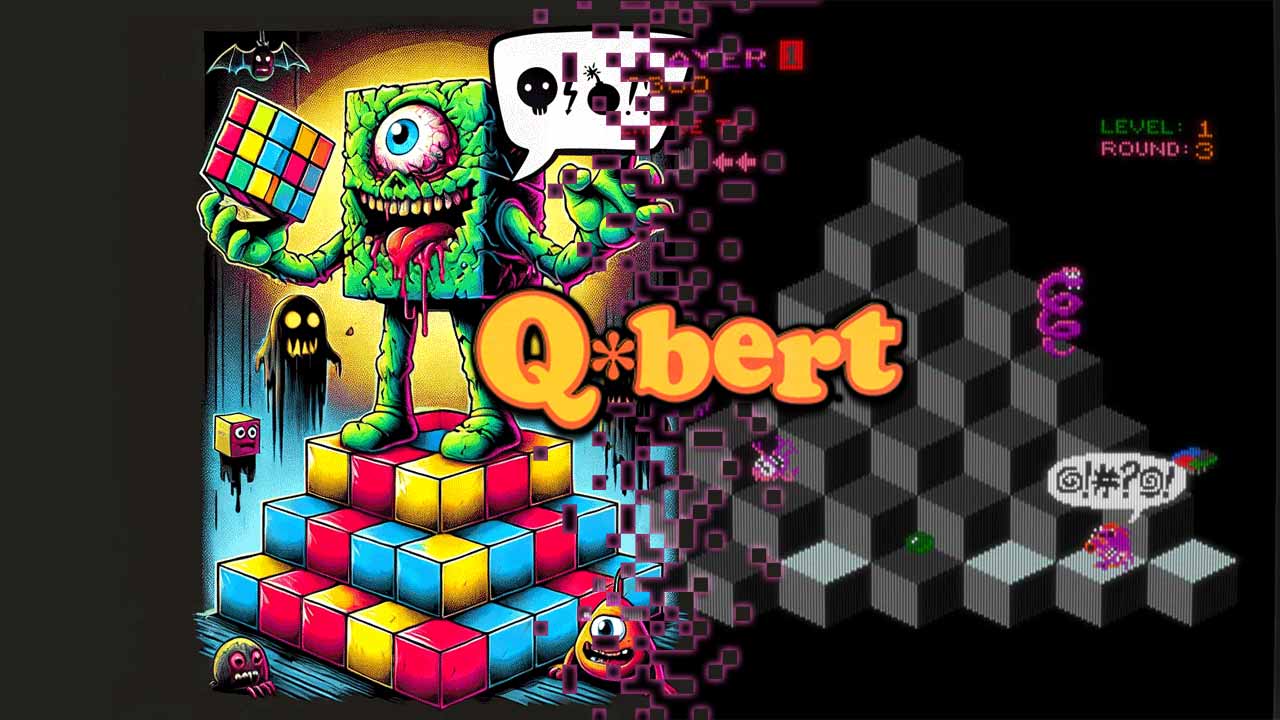
Q*bert, the iconic arcade hit from 1982, is one of the most recognizable games from the golden age of arcades. Developed by Gottlieb, it stands out with its quirky controls, unique visuals, and distinctive sense of humor.
What Q*bert Is All About: The Story of the Arcade Original
Q*bert doesn’t have a traditional storyline. It’s all about the gameplay and chasing the high score.
Chaos on the Cube Pyramid: The Addictive Gameplay
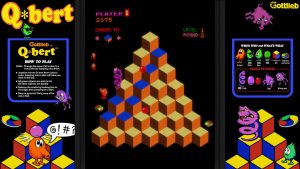
Q*bert’s gameplay is as simple as it is ingenious. You control Q*bert as he hops across a pyramid of square platforms, changing the color of each tile by stepping on it. Sounds easy? Think again! The diagonal control scheme requires a mental shift, making it particularly tricky for beginners. Every jump needs to be carefully planned, as even the smallest mistake can be fatal. To make things even harder, enemies are constantly getting in your way: Coily, the relentless snake, chases you down at every turn. Slick and Sam undo your hard work by reverting the tiles back to their original color. Later levels introduce even more challenges, such as tiles that need to be changed multiple times or moving platforms that add an extra layer of difficulty. This keeps the gameplay fresh and exciting. Each level feels like a small puzzle that requires skill, timing, and positioning to master.
Gameplay Trailer
This short video showcases the first level of Q*Bert in the Arcade. I intentionally focus on just the first level in my videos — no spoilers — to give you a feel for the gameplay, graphics, and sound without ruining the fun of discovering the rest yourself.
Loud Colors, Quirky Gibberish: The Graphics & Sound
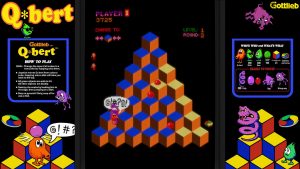
Q*bert’s graphics are minimalistic, with its pyramid-shaped playfield using an isometric perspective to create the illusion of depth. The colors are vibrant, making the game instantly recognizable. The main character’s iconic design – with his round nose and simple yet expressive look—makes Q*bert one of the most distinctive arcade mascots.While the game doesn’t have a full-fledged soundtrack, its sound effects are legendary. Q*bert’s signature swearing, represented by “@!#?@!”, still brings a smile to players’ faces today. Every jump is accompanied by a fitting sound effect, enhancing the dynamic gameplay experience.
How difficult is Q*Bert
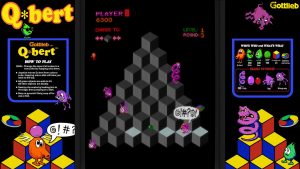
Q*bert is no walk in the park. The diagonal control scheme alone presents a challenge, as it requires players to rethink movement compared to traditional controls. For those used to standard directional inputs, this can be a major hurdle. As the game progresses, new difficulties emerge: Coily relentlessly chases you, while Slick and Sam undo your hard work by resetting your carefully colored cubes. Later levels introduce cubes that require multiple color changes, demanding precise timing and tactical thinking. The steadily increasing difficulty keeps players engaged but is certainly not for the faint of heart. Patience and perseverance are the keys to mastering Q*bert.
Multiplayer or Solo Only?
Unfortunately, there’s no direct multiplayer mode. However, the scoring system still gives you plenty of reasons to compete with friends at the arcade. Whoever sets the highest score has the final word! So it ultimately plays more like a classic hot-seat mode.



Conclusion & Rating: Is Nemesis Still Worth Playing Today?
Q*Bert
Conclusion
Q*bert remains a timeless arcade classic: challenging, addictive, and delightfully quirky. If you love retro games, this cult title is a must-play — despite its high frustration factor.

“Q*bert is a timeless classic that remains fun to play even today. Its quirky controls and progressively increasing difficulty keep the challenge engaging. If you’re a fan of arcade games, this is a title you simply can’t miss. But beware: the frustration factor can be just as high as the addiction factor!”
~ Roger Wilco ~
